Last Updated: October 25, 2026
Quick Summary
For most old oak stumps, oak stump removal is fastest with a track stump grinder that cuts the stump 8-12 inches below grade, leaving the root ball in the ground. Hand digging only suits stumps under 12 inches, and chemical treatment or burning is slow and risky.
- An oak stump takes 10 to 20 years to rot naturally, often longer.
- A grinder needs a gate roughly 36 inches wide or more for access.
- Within about 10 feet of a foundation, fence, or driveway, grinding is usually safer than pulling.
- Call 811 before you dig, every time, to locate underground utilities.
- Grinding below grade removes the growth points and stops oak regrowth most reliably.
Table of Contents
- Why Old Oak Stumps Are Harder to Remove Than You Think
- Stump Grinding vs. Stump Removal: What's the Difference
- How to Dig Out a Tree Stump by Hand
- Tree Stump Removal Tools: What You Actually Need
- Chemical Treatment, Drilling, and Controlled Burning
- How Long Does It Take for an Oak Stump to Rot?
- Oak Stump Removal Safety: Utilities, Regrowth, and Nearby Trees
- Get a Free Quote and Put the Stump Behind You
- Frequently Asked Questions
Why Old Oak Stumps Are Harder to Remove Than You Think
Here is the core problem most guides skip: oak wood is hard, and oak roots are harder. A fresh stump grinds into chips in minutes.
Age cuts both ways: old stumps crumble outside but hide voids and rot pockets underneath, so the ground is unstable and a machine can drop a wheel into a hollow without warning. For a deeper look at how stump age changes removal, see our full breakdown.
And one more thing worth knowing up front: many old oaks are not fully dead.
Below, we walk through seven proven methods, from hand digging to grinding, plus the costs, timelines, and safety rules that actually matter.
Stump Grinding vs. Stump Removal: What's the Difference
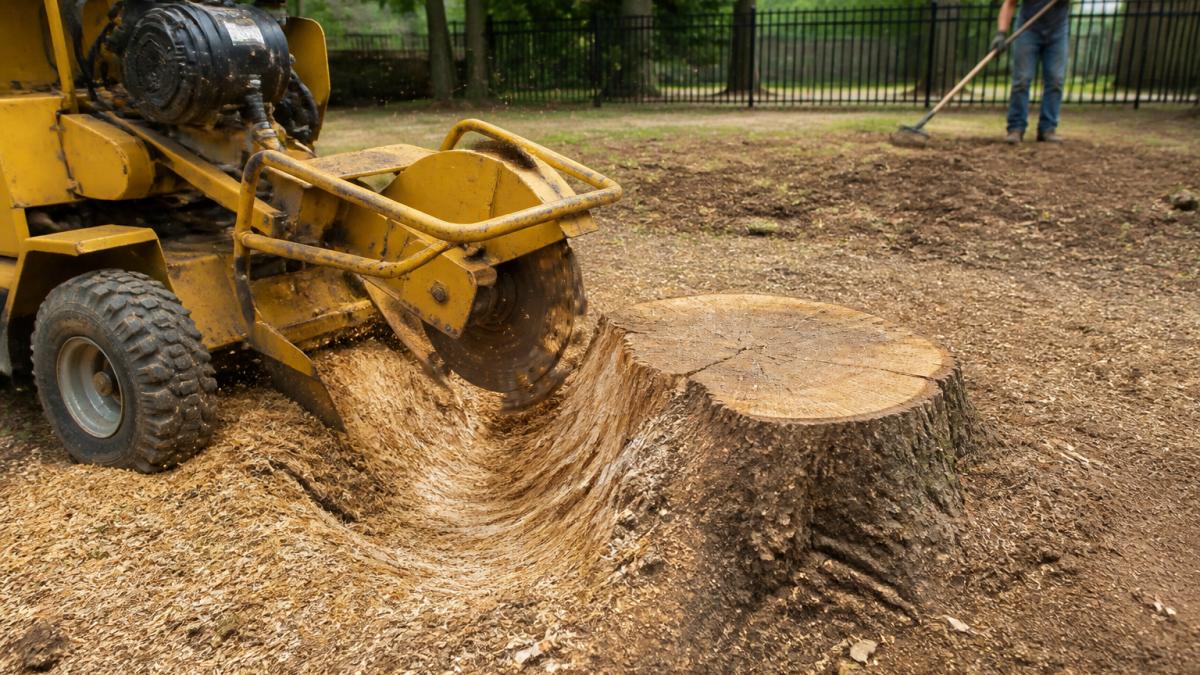
Stump grinding is the process of cutting a stump down below grade with a rotating carbide wheel, turning the wood into chips and leaving the root ball in the ground. Stump removal means pulling or excavating the entire stump and root ball out of the soil.
The distinction matters because the two jobs produce very different yards, timelines, and price points. For an old oak, the choice comes down to stump diameter, root proximity to structures, and how much disruption you can tolerate.
A Practical Decision Guide for Old Oak Stumps
Use stump diameter and site conditions to narrow the options before you rent anything or call a pro.
| Stump diameter | Best first option | Why |
|---|---|---|
| Under 12 inches | Hand dig or small grinder | Root ball is manageable; grinding is fast and clean |
| 12-24 inches | Track stump grinder | Hand digging becomes a multi-day job; grinding finishes in under an hour |
| 24-36 inches | Grinder or mini excavator | Grinding handles size; excavation is needed if roots heave hardscape |
| Over 36 inches | Professional grinder plus root management | Root ball weight and oak density make DIY risky |
Site conditions shift the answer as much as size does:
- Access. A grinder needs a gate roughly 36 inches wide or more. Narrow side yards often force hand tools or a smaller machine.
- Soil. Sandy soil drains and digs easily; heavy clay holds moisture and makes root balls heavier and harder to lever.
- Proximity to structures. Within about 10 feet of a foundation, fence, or driveway, grinding is usually safer than pulling because it disturbs less soil.
When Grinding Makes More Sense
- The stump sits near a fence, driveway, or foundation
- You want the least disruption to the surrounding lawn
- You plan to replant or build over the spot
When Full Removal Is the Better Call
- The stump is small enough to lift with equipment
- Roots are pushing up a patio, walkway, or foundation
- You need the root ball gone for new construction
Realistic Costs and Timelines
Costs vary by region, access, and stump size. Full removal with an excavator costs more because it involves digging, hauling, and backfill.
Timelines follow the same logic:
- Grinding: often under an hour of machine time for a standard oak stump, plus setup and cleanup.
- Hand digging: a full day or more for a stump under 12 inches; multiple days for larger stumps.
- Excavation: a few hours with a mini excavator, plus hauling and fill.
If you are weighing both options, our breakdown of the best way to remove stumps compares five methods side by side so you can match the approach to your yard.
How to Dig Out a Tree Stump by Hand
Hand digging works only on smaller stumps: expect a full day of hard labor for a stump under 12 inches across, and multiple days for anything bigger.
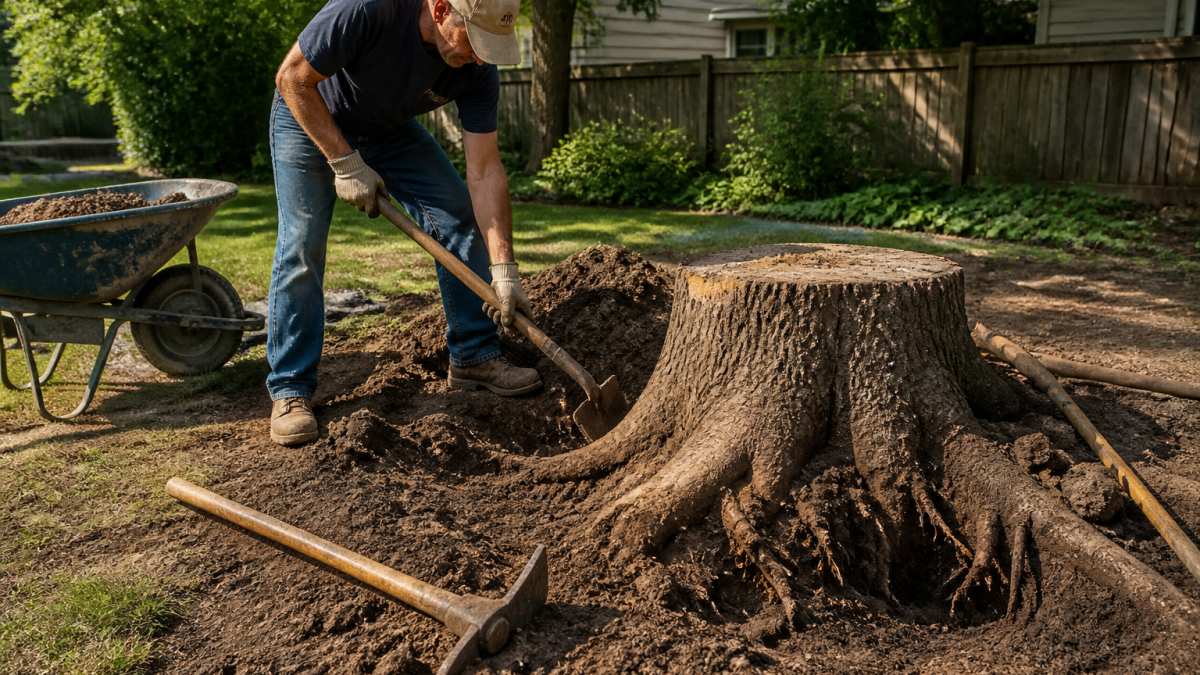
Here is the sequence we recommend:
- Clear the area. Remove grass, rocks, and debris in a 3-foot ring around the stump.
- Cut the roots. Use a mattock or root saw to sever roots on all four sides.
- Expose the root ball. Dig down and outward, following the main roots.
- Lever the stump. Work a digging bar or pry bar under the root ball and rock it loose.
- Pull it free. Use a truck, winch, or come-along to drag it out once it is loose.
- Fill the hole. Backfill with topsoil and tamp it down in layers.
The real limitation is the root ball. Oak roots run deep and wide, and a manual dig on a mature stump can take days of swinging a mattock. If the stump is over 18 inches across, save your back and call a pro.
Tree Stump Removal Tools: What You Actually Need
The tool list depends on the method, but most jobs come down to a handful of basics.
| Tool | Job It Handles | Rental or Buy |
|---|---|---|
| Mattock or pickaxe | Cutting roots, breaking soil | Buy |
| Digging bar | Levering the root ball | Buy |
| Root saw | Severing thick roots | Buy |
| Stump grinder | Grinding below grade | Rent or hire pro |
| Mini excavator | Pulling large root balls | Rent |
| Come-along or winch | Dragging the stump out | Buy or rent |
A brush puller helps on small saplings but will not touch a mature oak. For old stumps, a track-mounted stump grinder actually finishes the job.
Equipment access matters too: a grinder needs a gate roughly 36 inches wide or more. With a narrow side entrance, hand tools or a smaller machine may be your only option.
Chemical Treatment, Drilling, and Controlled Burning
Chemical treatment and burning are the two methods people ask about most, and both come with real caveats. For old oak the caveats are bigger, because oak roots spread wide, hold moisture, and can smolder underground.
Drilling and Chemical Treatment
Drilling and chemical treatment means boring holes into the stump and filling them with a stump-killing product or high-nitrogen fertilizer. The goal is to speed decay, not dissolve the wood; results take months to years, and the stump stays in your yard the whole time.
A few practical points:
- Hole pattern matters. Drill a ring of holes around the perimeter and several in the center, angled downward, so the product reaches the cambium layer where growth occurs.
- Fresh cuts respond better. Treat a stump soon after cutting if regrowth is the concern; old, dry oak absorbs product unevenly.
- Follow the label. Stump-killing products are registered pesticides, and the label governs application rate, season, and distance from water.
Controlled Burning
Controlled burning involves drilling holes, soaking the stump with fuel, and lighting it. It is legal in many areas but carries serious risk.
Before any fire, check local burning rules. Many jurisdictions restrict open burning, require a permit, or ban it outright during dry periods, and some prohibit burning stumps altogether.
The University of Illinois Extension guide to stump decay lays out a safer path: increase the stump's surface area, aerate the soil, manage moisture, add nitrogen, and inoculate the wood.
Underground Utilities and Safe Digging
Any method that disturbs soil, digging, grinding, or excavation, should start with a utility locate. Call 811 before you dig, every time (811 Before You Dig). Gas, water, and electrical lines run shallower than most people expect.
Also check for private lines the utility service may not mark, such as irrigation, landscape lighting, or a septic line. If you are unsure, hand-dig carefully near the stump before bringing in equipment.
Oak Regrowth and Root Management
Oak is a vigorous sprouter: if the tree was cut while still alive, the stump can send up new shoots within a season. Chemical treatment can reduce regrowth, but grinding below grade removes the growth points and is the more reliable fix. Watch for root suckers some distance from the stump; repeated mowing weakens them, but they can persist for years.
How Long Does It Take for an Oak Stump to Rot?
An oak stump takes 10 to 20 years to rot naturally, often longer.
That timeline is why most homeowners stop waiting: a stump that sits for a decade becomes an insect home, a trip hazard, and a mowing obstacle.
If you do want to speed decay, the Extension steps above help, but they still work on a scale of years, not weeks.
Curious what your yard looks like once the stump is gone? Our guide to what happens to your yard after stump grinding covers chip cleanup, filling the hole, and restoring the lawn.
Oak Stump Removal Safety: Utilities, Regrowth, and Nearby Trees
Safety is where DIY stump jobs go wrong most often. Three risks matter before any machine starts.
Underground utilities. Call 811 before you dig, every time.
Regrowth. Oak sprouts vigorously: a stump cut while the tree was alive can send up new shoots within a season.
Nearby trees. Oak roots connect to neighboring trees more than people realize. Digging or grinding too close can damage a healthy tree you meant to keep.
One more concern: old stumps attract pests. Our post on the pests hiding in your yard explains what lives in a dead stump and why removal is the fastest fix.
Get a Free Quote and Put the Stump Behind You
Old oak stumps are stubborn, and the wrong method wastes your weekend and your money.
Gone In One Grind utilizes a professional-grade track stump grinder to leave your lawn clean. We offer same-week service, honest pricing with no hidden fees, and we are fully insured.
Stop mowing around it. Get a free quote and we will get back to you fast with a clear price and a date on the calendar.
Frequently Asked Questions
What is the most effective way to remove an old oak stump?
Grinding is usually the most effective method for an old oak stump. A track stump grinder cuts the wood 6 to 12 inches below grade, which clears the surface for replanting or building and leaves the surrounding lawn mostly intact. Hand digging works for small stumps but becomes slow and expensive once the root ball is large. Chemical treatment and natural decay take years and leave the stump in place. For a thick oak stump, professional grinding is the fastest route to a level yard.
How long does it take for an oak stump to rot on its own?
Oak is a dense hardwood, so a stump left to decay naturally can last well over a decade. The University of Illinois Extension recommends speeding the process by increasing surface area, aerating the soil, managing moisture, adding nitrogen, and inoculating the wood, but it gives no completion-time benchmark. In practice, expect several years even with those steps. If you need the space back this season, grinding or digging is the realistic option.
Can I remove an oak stump by digging it out myself?
You can dig out a small oak stump, roughly under 12 inches across, with a shovel, mattock, and loppers. Cut roots as you expose them, then lever the stump free. Larger stumps have heavy root balls and often require a mini excavator or a stump grinder. Before any digging, call 811 to have underground utilities marked. Digging near gas, electric, or irrigation lines without a locate is a real safety and liability risk.
Will grinding an oak stump stop it from growing back?
Grinding removes the stump and the visible root crown, which stops most regrowth. Oak can still send up shoots from roots left in the soil, so watch the area for suckers in the first season and cut them promptly. Grinding 6 to 12 inches below grade removes more of the crown and reduces the odds of resprouting. If the tree was already cut and the stump has been sending up shoots, mention that when you request a quote so the crew can grind deep enough.
