
If you've noticed more dead or dying ash trees in your neighborhood over the past few years, you're not imagining it. A metallic green beetle smaller than a penny — the Emerald Ash Borer (EAB) — has quietly become one of the most destructive forces in Chicagoland's urban forest.
What Is the Emerald Ash Borer?
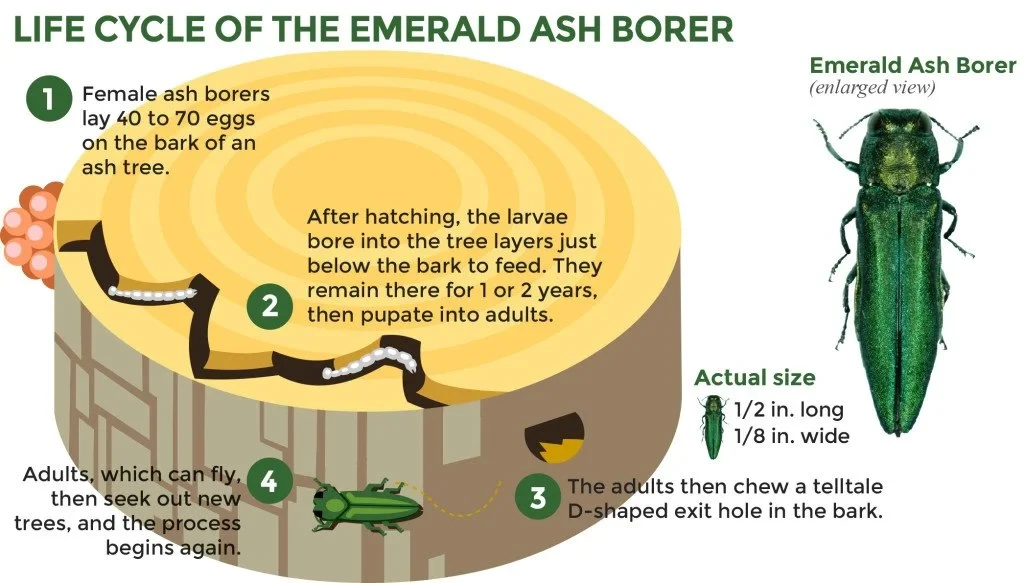
EAB is an invasive beetle native to Asia, first discovered in the U.S. near Detroit in 2002. It reached Illinois by 2006 and has since spread through nearly every county in the state, including DuPage, Will, Kane, and Cook. The adult beetle is harmless-looking, but its larvae are the real threat — they tunnel beneath the bark and cut off the tree's ability to move water and nutrients.
Once a tree is infested, there's no reversing the damage. Nearly 100% of untreated ash trees die within 2 to 4 years of infestation.
Why It Matters So Much Here
Ash trees were planted heavily throughout Illinois subdivisions in the 1970s–90s, largely because they were a fast-growing replacement after Dutch elm disease wiped out the region's elms. That popularity is exactly why EAB has hit so hard — entire streets and parkways lined with ash trees are now dying at the same time.
Municipalities across DuPage and Kane counties have spent millions on removal and replacement programs. For homeowners, a single mature ash removal can run well into four figures once you factor in tree removal, cleanup, and what's left behind: the stump.
Signs Your Ash Tree Is Infested
- Thinning canopy or dieback starting at the top of the tree
- D-shaped exit holes in the bark (about 1/8 inch wide)
- Vertical bark splits exposing S-shaped larval tunnels
- Increased woodpecker activity — they're feeding on the larvae
- Sprouting ("epicormic growth") at the base of the trunk
If you're seeing two or more of these signs, it's worth having a certified arborist evaluate the tree before it becomes a safety hazard.
The Stump Problem Nobody Talks About
Tree removal companies handle the tree — but the stump is often left behind, or it's an added cost that catches homeowners off guard. And EAB-killed ash stumps don't just sit there quietly: they can become breeding grounds for other pests, attract fungus, and turn into a tripping hazard or mower obstacle for years if left untreated.
That's where we come in. Once your ash tree is down, grinding the stump below grade lets you reclaim the space — whether that's for new landscaping, sod, or just a yard you don't have to mow around anymore.
What to Do If You've Lost an Ash Tree
- Confirm removal is complete and check whether your tree service left the stump behind
- Get a stump grinding quote — we price by stump diameter, so it's a straight number, not a guess
- Consider replanting with a non-ash species (Illinois arborists generally recommend diversifying — oaks, lindens, and disease-resistant elms are solid replacements)
Bottom Line
Emerald Ash Borer isn't going away, and if you've got an ash tree still standing in Naperville, Aurora, Wheaton, or anywhere in DuPage and the surrounding counties, it's worth having it checked. And if you've already lost one, don't let the stump linger — one visit, and it's gone.
Got a stump from a removed ash tree? Send us a photo for a free quote →